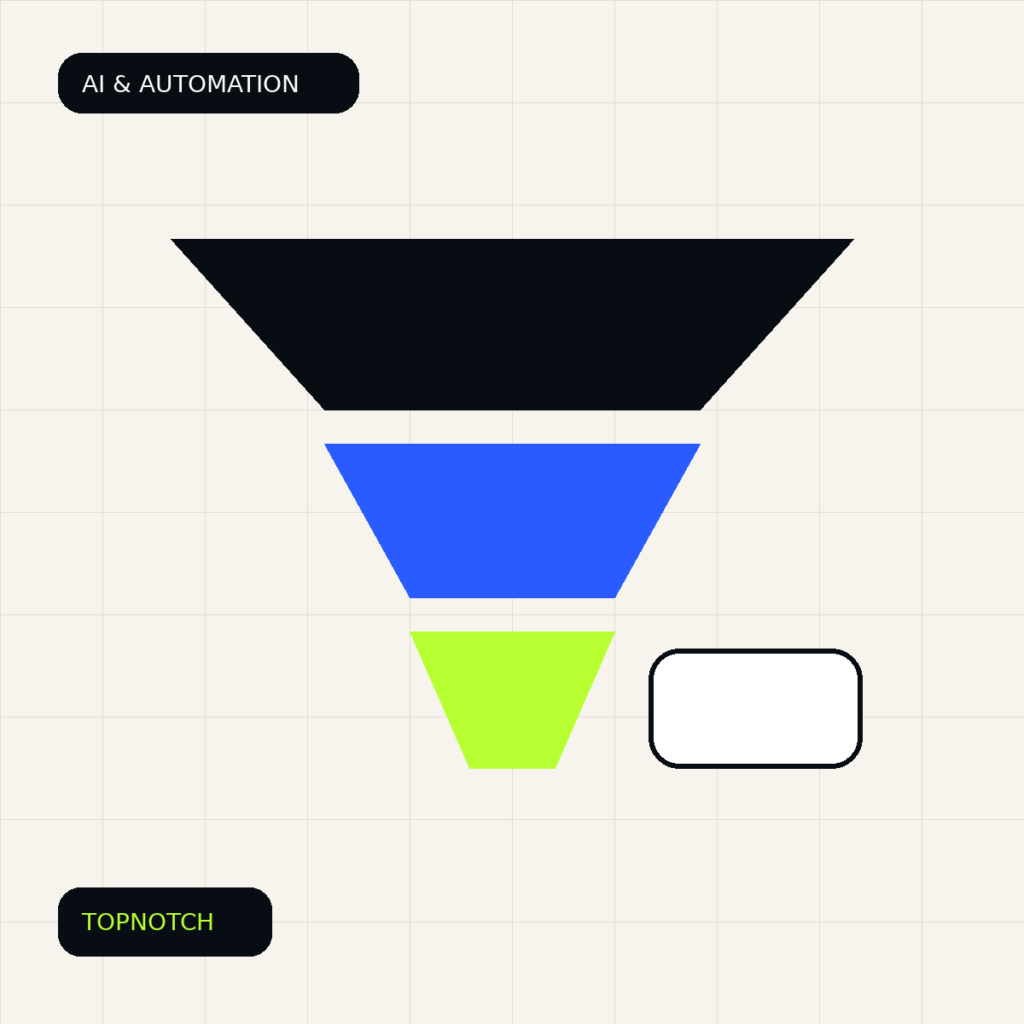
Lead qualification sounds attractive because nobody wants a sales team spending hours on enquiries that clearly do not fit. The risk appears when an AI score quietly becomes a gatekeeper and a promising prospect is rejected because the system misunderstood a short message.
A safer design treats AI qualification as decision support, not unquestioned authority.
Start with criteria your business can explain
Before adding AI, write down what “qualified” actually means. It might include service fit, location, timeline, minimum project scope or whether the person has authority to make a decision.
If the criteria are vague in the business, automation will not make them clearer. It may only hide the ambiguity behind a score.
Collect missing information before judging the lead
Imagine someone writes, “Need help with our website ASAP.” That message is incomplete, but it is not necessarily a poor lead.
An automated workflow can ask two or three sensible follow-up questions before assigning a category. For example:
- What problem are you trying to solve?
- Do you already have a WordPress website?
- When would you like the work to begin?
This is more useful than penalizing the lead for not writing a detailed brief on the first attempt.
Use bands instead of a single “accept/reject” decision
A practical setup might classify leads as:
- Ready for human review
- Needs more information
- Likely outside scope
Notice that even the last category does not require an automatic rejection. A person can review edge cases.
Watch for criteria that create unfair shortcuts
Do not use irrelevant personal characteristics as proxies for commercial fit. If you cannot explain why a factor is necessary to provide the service, it probably should not be part of the qualification rule.
The NIST AI Risk Management Framework emphasizes governance, measurement and risk awareness. The Generative AI Profile adds guidance specific to generative systems.
Make the human review fast
Automation is still useful even when a person approves the final routing. The system can summarize the enquiry, highlight missing details and suggest a next step so the reviewer is not starting from zero.
Our AI Lead Qualification service is designed around that principle: speed up triage without pretending a model can perfectly judge every prospect.
Review false negatives, not only successful leads
Businesses often measure how many “good” leads the system identified. You also need to inspect the leads it downgraded. That is where hidden mistakes show up.
If a human regularly overturns the same automated decision, update the workflow. Qualification should learn from operational evidence, not become a permanent black box.